
The Chinese and the Sangleys
China trade
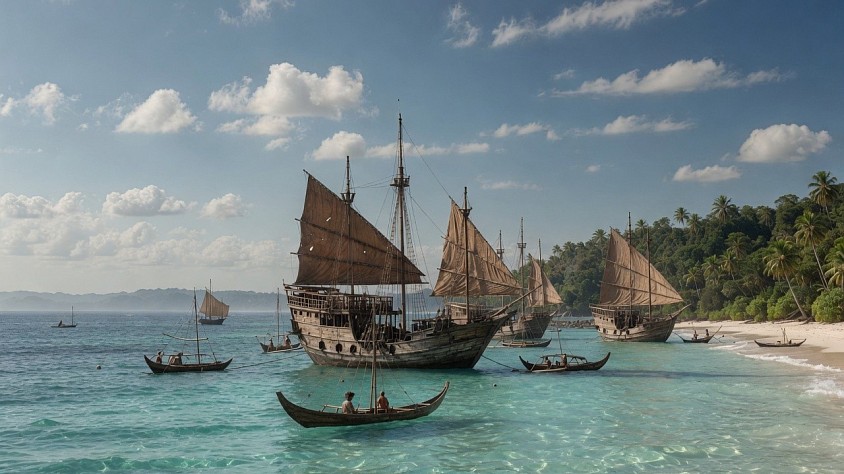
The period from 1000 to 1565 AD marked a dynamic phase of Sino-Philippine interactions, where Chinese merchants integrated the archipelago into Asia’s maritime trade networks, influencing local economies, cultures, and polities. Imagine the salty tang of sea spray mingling with the earthy aroma of tropical woods as Fujianese junks, their sails billowing like dragon wings against the azure horizon, sliced through the warm South China Sea waves. Archaeological finds, such as Tang and Song dynasty ceramics—glossy blue-and-white porcelain shards that once gleamed under the sun—in sites like Butuan, Cebu, and Manila Bay, indicate that exchanges began as early as the 9th century but surged during the Song Dynasty (960–1279 AD). Driven by China’s naval prowess and demand for exotic goods, these traders bartered delicate silk fabrics that whispered against the skin, sturdy ironware clanging in crates, and colorful beads rattling in pouches for the archipelago’s treasures: shimmering gold dust, lustrous pearls that caught the light like dewdrops, sticky beeswax with its faint honeyed scent, iridescent tortoise shells, and fragrant aromatic woods like sandalwood, whose smoky perfume lingered in the humid air. Polities like Ma-i (likely Mindoro or Luzon), Butuan, and Sulu became key hubs, with Filipinos navigating balangay boats—creaking wooden vessels powered by rhythmic paddle strokes—to facilitate regional commerce amid the cacophony of waves crashing and merchants haggling.
Chinese influence was particularly pronounced around Manila Bay, where a thalassocracy flourished since at least 900 AD, centered on polities like Tondo and Maynila. This strategic location controlled river and bay routes, serving as gateways for trade between China, Southeast Asia, and the Indian Ocean, where the muddy Pasig River’s brackish waters carried the mingled smells of fish markets and blooming mangroves. Chinese records, such as Chau Ju-Kua’s 13th-century accounts, describe Manila as a prosperous riverside settlement of about a thousand families, where honest locals bartered with visiting junks anchored midstream, their decks alive with the shouts of sailors and the sizzle of stir-fried meals wafting spicy ginger and garlic aromas. While large permanent colonies were absent, some Chinese merchants settled temporarily, intermarrying with indigenous populations and establishing small communities that buzzed with the hammer strikes of blacksmiths and the earthy scent of fired clay from pottery kilns. These settlers played crucial roles as intermediaries, introducing technologies like advanced metallurgy and pottery, and fostering hybrid families that blended Hokkien customs—such as the tangy taste of fermented soy—with local traditions. By the early 16th century, periodic Chinese visits had enriched the area economically, with goods like silk and porcelain becoming status symbols among datus (chiefs), their smooth textures coveted in humid, sweat-dampened feasts. When Spaniards arrived in 1570, they encountered around 40 married Chinese in the Manila area, highlighting pre-existing settlements that aligned variably with local rulers or newcomers during conflicts. Concurrently, Islamic influences permeated Manila Bay through trade ties with Brunei and Borneo, introducing superficial Muslim customs by the 15th century, primarily to facilitate commerce rather than deep conversion, amid the calls to prayer echoing over the bay’s misty dawns and the spicy scent of clove-laced curries from Bornean traders. Maynila became a Muslim vassal to Brunei, with rulers like Rajah Sulayman adopting Islam, blending it with animist practices and enhancing trade in spices, textiles, and slaves across Southeast Asia.
In the southern archipelago, particularly Sulu, Islamic settlements and trade flourished from the late 13th century, predating full sultanates. Muslim traders from Borneo, Arabs, and Malays arrived by the 10th century, with Sheikh Makhdum Karim establishing Islam in Sulu around 1380 through missionary work and commerce, where the air hummed with the rhythmic chants of the adhan and the briny scent of pearl-diving harvests. The Sultanate of Sulu, founded circa 1405 by Sharif ul-Hashim (Abu Bakr), became a Sunni Muslim state controlling the Sulu Archipelago, parts of Mindanao, Palawan, and Borneo. Sulu evolved into a bustling entrepôt, trading pearls, shells, and woods with China, Java, Sumatra, and Cambodia, while introducing Islamic governance, law, and cultural elements like Arabic script and mosques, all amid the vibrant markets filled with the clatter of bartering and the sweet-sour tang of tropical fruits. This paralleled Chinese trade, creating a multicultural nexus where Muslim merchants facilitated exchanges, resisting external domination until Spanish incursions.
In Cebu, part of the Visayan polities, Chinese trade was equally vital but often mediated through local networks. The Rajahnate of Cebu (c. 1400–1565) thrived on maritime exchanges, with Chinese goods arriving via intermediaries from Luzon or Mindoro, their arrival heralded by the distant creak of oars and the gleam of sunlit sails. Archaeological evidence of Song-era artifacts suggests regular contact, where Cebuano traders exchanged gold, cinnamon with its warm, spicy bite, and pearls for Chinese porcelain and textiles. Small Chinese settlements or sojourner communities likely existed in coastal areas, facilitating barter and cultural diffusion amid the crash of waves and the chatter of multilingual negotiations. When Miguel López de Legazpi’s expedition reached Cebu in 1565, local merchants quickly brought junks laden with Chinese wares, demonstrating established trade links that informed Spanish ambitions for direct Sino-Spanish commerce. These settlers contributed to technological transfers, such as improved shipbuilding and agriculture, while intermarriages created mestizo lineages.
Under the Yuan (1271–1368) and Ming (1368–1644) dynasties, the Philippines joined China’s tributary system, with envoys from Butuan and Sulu visiting the imperial court to exchange tribute for recognition, underscoring diplomatic ties without subjugation, journeys filled with the roll of ocean swells and the exotic flavors of court banquets. The term “Sangley,” from Hokkien “seng-li” (business), encapsulated these traders’ entrepreneurial spirit. Despite Ming maritime bans, smuggling sustained flows, blending economies and societies. Islamic influences from Borneo added layers in the south, but Chinese trade remained pivotal. This era’s legacies—cultural fusions in folklore, cuisine, and artistry—paved the way for the Manila Galleon trade post-1565, linking Asia to the Americas amid colonial shifts.