
The Grand Antithesis
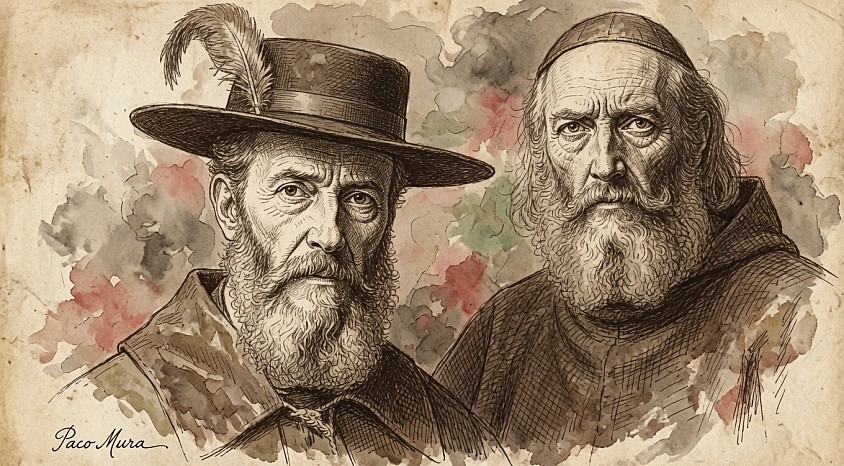
Legazpi & Urdaneta, the Grand Antithesis!
I, the Eternal Witness, who for ages unnumbered have gazed upon the convulsions of empires and the silent agonies of human souls across the tragic theater of centuries; I who beheld Rome crumble beneath the barbarian tide and Jerusalem rise from her ashes; I who followed Augustine amid smoking ruins and watched Columbus pierce the unknown ocean—I now turn my gaze, in this year of our Lord 1564, to that lonely quarterdeck upon the measureless Pacific.
There, beneath a sun that spared no weakness of mortal clay, two men confronted each other upon the heaving deck—living symbols of the eternal duel that has rent asunder the soul of mankind. One embodied the ardent dream of the City of God, Saint Augustine’s radiant commonwealth where souls loved the Eternal above themselves and thirsted for the peace that passeth all understanding. The other embodied the grim City of Man, that workshop of self-love, earthly glory, and dominions that crumble into dust.
Ah! I saw it all in that present hour: the grand antithesis that had torn humanity since the first crime and the first prayer, condensed into two human hearts aboard that frail oak vessel cleaving the indigo swells. Never had the drama burned more fiercely, nor the stakes risen higher, than upon those restless waves where immortal souls trembled between heaven and the abyss.
The mist of Guipúzcoa clung to them like the breath of destiny. On the quarterdeck of the San Felipe stood Miguel López de Legazpi and Andrés de Urdaneta. Salt spray beaded upon their lashes, the ship groaning through swells like the bosom of a primordial goddess, the air heavy with brine, hot tar, resinous pitch, and baked wood.
Beneath the eternal slap of the waves lay a fracture deeper than any chasm: two irreconcilable visions of the fleet’s purpose. For Urdaneta it was the City of God descending like the New Jerusalem; for Legazpi, the clay of empire molded into a bastion for Castile. I, who had witnessed Babylon’s fall and the Cross over pagan altars, saw in their silent opposition the very soul of history—the idealist and the builder, each incomplete without the other.
Urdaneta, the Augustinian friar of sixty-four, gripped the rail with hands scarred by coral and mosquitoes. His coarse white habit whipped about him; his face bore the marks of tempests and eight arduous years in the Maluku Islands. Born around 1500 in Bilbao, he had sailed with the doomed Loaísa expedition, suffered shipwreck on Mindanao, and returned transfigured. This voyage was holy reconnaissance: peaceful missions, the tornaviaje binding New Spain to the Orient without shattering papal lines. Conquest was poison; evangelization demanded humility and Augustine’s communal vision.
Beside him stood Legazpi, two years younger, silver threading his beard. Born in 1502 in the Jáuregui Tower, he was no seafarer but a royal notary, cabildo secretary, alcalde mayor, and mint overseer whose hands knew abacus beads and encomienda deeds better than any cutlass. At sixty-two he beheld Philip II’s charge with the eye of a steward of the earthly city: permanent colonies, enduring trade routes, measured force when necessary. As Augustine conceded amid barbarian hordes, the earthly city sometimes required the sword’s reluctant edge.
What a spectacle for the Eternal Chronicler! Two Basques, kin by blood and rugged soil, divided by the grandest schism: the luminous City of God versus the laborious City of Man, locked in a divine dialectic propelling history through tears and blood.
Their antithesis had crystallized months earlier in the viceregal palace in Mexico City. Amid copal smoke and rushlight, Viceroy Luis de Velasco unfurled royal instructions. Urdaneta’s prophetic voice rang clear: “We sail as witnesses, not conquerors. Missions without garrisons. Friendship first. We skirt Portuguese claims and return with charts of mercy. Natives are souls hungering for light; the City of God rises by grace alone.”
Legazpi replied with measured cadence: “The Crown commands settlements and forts. The Pacific has devoured fleets before us. We must root ourselves like ancient oaks or bleed treasure and souls into the void. I share your piety, cousin, yet the earthly city demands walls against chaos. We fortify what grace plants.”
Tension simmered through preparations at Puerto de la Navidad. Four vessels groaned at anchor, laden with manioc, salted pork, and hardtack. Five Augustinians heard confessions and offered communion. Urdaneta enforced daily prayers and prohibition of blasphemy. Legazpi reviewed manifests, appointed officers, and culled useless mouths. Their arguments drifted like opposing winds—one evangelical purity, the other pragmatic empire.
One golden evening the clash broke open upon the quay. Urdaneta cried, “We plant crosses of olive wood, not banners of conquest! Loaísa’s fleet shattered on avarice. I walked those isles—clove smoke and mangrove muck. Offer friendship and Christ’s poverty!”
Legazpi answered steadily, “I have balanced ledgers of blood and grace in México for thirty years. A colony without walls falls to monsoon or rival. We maneuver with alliances and measured force. The City of God needs earthly foundations.” Kinship tempered disagreement. They embraced, the antithesis tempering the expedition like steel in contrasting fires.
The crossing was a descent into inferno. Sixty days of indigo swells, bilge reek, and scurvy’s ghastly bloom. Urdaneta paced decks murmuring Augustine, plotting the tornaviaje by star and journal. Legazpi quelled mutterings with justice tempered by mercy, debating over xocolatl in lantern-lit quarters. Their voices rose and fell—philosophy against pragmatism—finding reluctant harmony.
Landfall in the Visayas in March 1565 brought emerald shores exhaling humid rot and frangipani musk. Natives approached in outriggers, bodies gleaming with coconut oil. Urdaneta went ashore with gifts and Malay-learned phrases: “We come in peace, bearing faith that frees from idols.” Hard-won fluency glowed within him like a lantern, birthing visions of bamboo chapels, shared toil under the Augustinian Rule, and grace dawning without fire and iron.
Legazpi noted sheltered coves and fertile soil, authorizing parley backed by arquebusiers. “Friendship where possible,” he instructed, “defense where necessity.”
Tension peaked on Cebu. Rajah Tupas mustered warriors, proud of lineages trading with Chinese and Borneans. On April 27, 1565, after gifts and three days’ grace, the shore erupted with war drums and kampilan blades. Legazpi ordered fire. Artillery thundered; smoke billowed. Landing boats surged ashore. Urdaneta accompanied them, crucifix high, chanting Latin amid chaos, offering mercy and last rites even as blood stained the sand.
The clash was brief yet ugly—a microcosm of ideal versus real. Warriors surged bravely; a Spanish soldier fell, a Cebuano chieftain crumpled. Arrows rained; one grazed Legazpi. He directed formations with crisp commands while Urdaneta prayed, heart fracturing at the cost. Natives broke into the interior. Spaniards raised stockade and crude monastery.
That night Urdaneta whispered, “This is not evangelization. We have strayed into the bloody tumults of the earthly city.” Legazpi replied heavily, “Yet here we root ourselves like the olive tree. Trade will flow; your tornaviaje will bind it. God forges strength from contrast, as Augustine built amid Rome’s ruins.”
The battle of Cebu forged the expedition’s antithesis in fire and tears. Urdaneta’s fire never dimmed. With Martín de Rada he charted the return route, guiding the San Felipe eastward in October 1565 through scurvy and tempests, proving the path for the Manila Galleon trade.
Legazpi governed the colony, forging alliances with diplomacy and steel, pressing toward Manila. Settlements grew: churches beside forts, missions peaceful where possible yet shielded by necessity.
Their contradiction proved providential. Urdaneta preserved moral legitimacy and delayed war with Portugal. Legazpi secured footholds against monsoon, rivals, and revolts. When Urdaneta returned triumphant to Acapulco bearing charts of seas and souls, the colony pulsed with galleons and incense.
Until Urdaneta’s death in 1568 and Legazpi’s in 1572, the cousins remained bound by blood and burden. Letters crossed the Pacific—Augustinian reflections mingling with practical reports. The friar seeded souls; the administrator gave them soil and walls.
The antithesis completed their kinship, as day completes night. Basque iron tempered in differing fires forged one enduring blade. Far to the west the Pacific still whispers their names where emerald waves meet coral, incense curling beside fading cannon smoke. Together they wove fragile threads of a route binding worlds for centuries—proof that antithesis, borne in humility and courage, becomes under grace the grandest harmony.
And I, the omnipresent observer, close this chapter with reverence. In such men and tensions lies the secret of human progress: not purity alone, nor power unchecked, but the faithful tension between the two, by which God draws all things toward Himself.