
Pacific, How it All began!
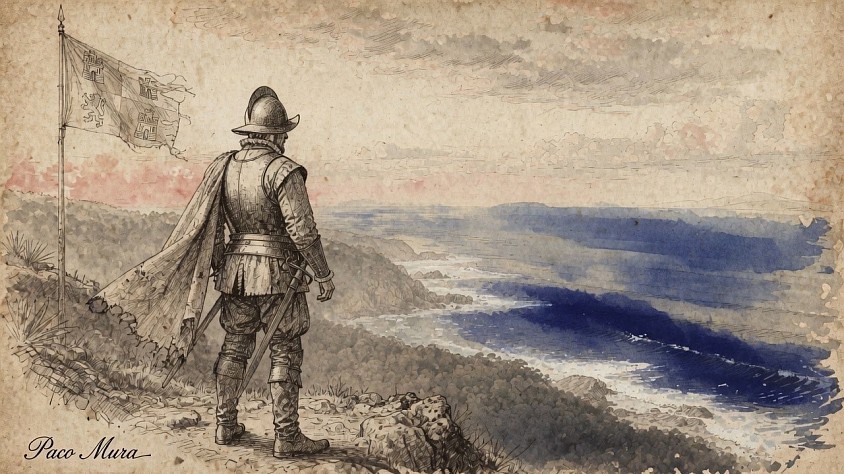
Vasco Núñez de Balboa looking at the Pacific Ocean in 1513
In the vast and sombre theatre of the ages, where the Eternal Hand traces upon the unfathomable map of the seas the colossal destinies of empires and the secret dramas of souls, there appears, like a flash of lightning across the storm-clouds of History, a sublime and terrible spectacle.
It was in that fateful September of the year of grace 1513 that Vasco Núñez de Balboa, that son of Extremadura born of iron and hunger, a man half bandit and half demigod, rent asunder the pestilential bosom of the Isthmus of Panama. At the head of a handful of companions as fierce as himself, he emerged from the green hell of the jungle—tattered, bloodied, yet transfigured—upon the shore of an unknown ocean. He strode into the foaming waves, sword raised like a challenge hurled at the very face of Infinity, and in a voice that seemed to awaken the echoes of Creation itself, he claimed for the Crown of Castile that immense, mysterious Mar del Sur, with all its veiled continents, its sleeping islands, and its unborn glories.
Before his devouring gaze stretched not merely waters, but the very heart of the world laid bare. He beheld rivers of gold, oceans of pearls, empires yet to crumble like dust beneath the heel of destiny. It was a discovery raw, violent, and magnificent—a Promethean cry torn from the breast of humanity, a conquest achieved by the sheer fury of will and the cold kiss of Toledo steel. The planet itself seemed to tremble at this audacious unveiling. Yet it remained but a vision! The giant ocean lay unveiled, yet unconquered. Balboa turned his back upon that azure immensity and returned to the fever-haunted shores of the Caribbean, his soul still athirst, his dream unfulfilled. The Pacific had been revealed to Man—but Spain had not yet crossed its sacred threshold.
Half a century had rolled by, as if History herself—that august and eternal matron, veiled in the mists of ages and crowned with the ruins of fallen empires—had paused upon the threshold of her temple. There she drew a deep and solemn breath from the very lungs of Time, a silence vast and pregnant with destiny. In that hush the echoes of forgotten conquests slumbered, while the winds of the sea whispered prophecies to the listening stars.
Then, upon those same majestic shores—bathed in the golden light of the Pacific and guarded by the eternal ramparts of cloud-wreathed volcanoes—there arose another figure, colossal against the horizon of fate: Miguel López de Legazpi, the iron-willed Basque. Stern as the judgment of Heaven, unyielding as the granite ramparts of his native Pyrenees—those ancient giants that lift their snow-crowned brows to the thunder and defy the tempests of centuries—he stood, a living embodiment of the indomitable will of Spain, forged in the mountains and tempered in the fires of unquenchable ambition.
In his gaze burned the cold flame of resolution; in his breast beat the heart of a conqueror who knew neither doubt nor mercy, only the inexorable march of Providence.
He came not as a discoverer trembling before the unknown, but as its predestined master. In 1564, from the ports of New Spain, he launched his frail fleet of galleons across the void, accompanied by the sons of Saint Augustine—those humble soldiers of the Cross. What Balboa had glimpsed in rapturous frenzy, Legazpi seized with the calm, inexorable force of a founder and a lawgiver. He crossed the enormous breast of the Pacific and planted, upon its farthest rim, not a fleeting banner, but the enduring standard of Spain and of Faith.
Where Balboa had claimed the waters with a flashing sword, Legazpi claimed the islands with law, with settlement, with the living fire of evangelization. His expedition was no mere raid of rapine and plunder, but a pilgrimage ordained, as the devout chroniclers believed, by Heaven itself. In the emerald Islas del Poniente, Spain beheld a new and sacred beginning: the “Isles of God,” a virgin field offered to the eternal harvest of souls, untouched by the bloody tempests then rending Europe asunder.
Thus do these two titans stand immortal in the majestic procession of Spain’s oceanic epic.
Balboa, the daring scout, the Promethean herald, flung open the colossal doors of the Pacific with a cry that shook the world. Legazpi, the steadfast founder, the architect of empires and cathedrals of the soul, strode through those same doors and there raised, upon the distant edge of the earth, a house that would endure—a house of faith, of justice, and of undying glory.
One revealed the ocean. The other wedded it to destiny.
This sublime vision found profound echo in the soul of King Philip II, that monarch consumed by fervent religious conviction and by the profound anxiety for his own eternal salvation. Moved by the impassioned warnings of Bartolomé de las Casas, that Dominican friar who thundered like an ancient prophet against the brutal exploitation of indigenous souls, Philip trembled lest Spain, in mistreating these children still dwelling in spiritual darkness, should draw down upon herself the judgment of Heaven. He saw in colonization not mere conquest, but a sacred duty: gentle pacification, systematic evangelization, protection of the weak. In truth, the Philippines became the Isles of God—a fresh theater where Saint Augustine’s City of God could rise through merciful instruction and the patient gathering of souls.
In this fateful stroke, vaulting ambition and burning faith sailed together across the boundless Pacific, renewing upon its waters humanity’s primal and eternal drama.
There, in Legazpi’s frail fleet, Saint Augustine’s immortal antithesis found living flesh. The City of Man raised its towers of pride and avarice: clinking coins, thundering cannon, whispered treacheries, and the blood of the vanquished. It loved itself to the contempt of God. Yet within the same vessels pulsed the invisible City of God—humble, eternal, built of living stones: contrite hearts, obedient wills, and love turned toward the Creator. Its victories were not measured in leagues conquered, but in souls turned toward the redeeming Cross.
Ambition stood at the helm; Faith scanned the heavens from the crow’s nest. Greed muttered in the darkened holds; prayer rose with the creaking of the timbers. These twin cities clashed and embraced, driving the fleet through storm and calm, through sin like jungle miasma and expiation like the first breath of dawn.
For History unfolds not in neat divisions, but in titanic wrestling within empires and within the depths of the human soul. Every voyage across the deep is a chapter in humanity’s immense destiny—toward divine mercy, toward justice, toward that final hour when the trumpet shall sound and the two cities shall stand revealed, born of the same clay yet separated for eternity.
Thus endures the legacy of Legazpi. The Isles of God shine not merely as earthly conquests, but as altars where eternal light meets mortal striving, where the infinite drama of Man and his Creator continues beneath the tropical sun.