
King Philip II of Spain
The Prudent King
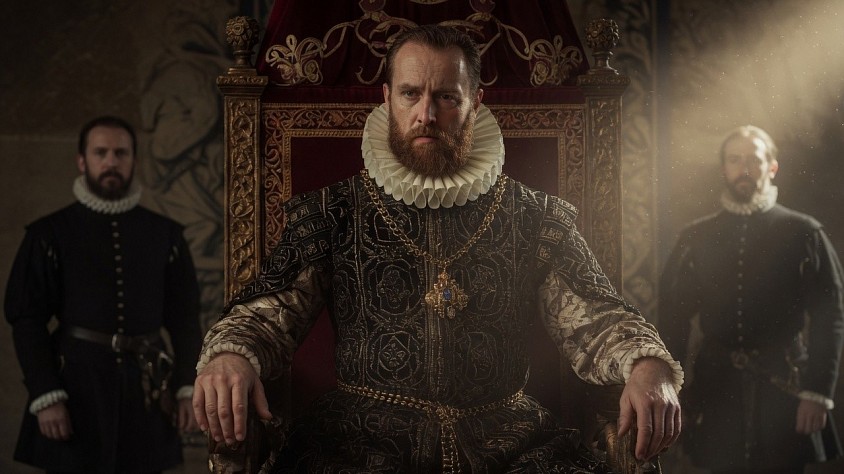
Philip II (1527–1598), son and heir of Charles V, ascended Spain’s throne in 1556 as the architect of absolutism, transforming his father’s sprawling inheritance into a centralized colossus of conquest that dominated the globe. Nicknamed “the Prudent” for his meticulous governance, Philip wielded a bureaucracy of ink and steel to extend Habsburg dominion, blending Catholic orthodoxy with unyielding territorial ambition. Under his rule, Spain’s empire ballooned from the Americas to Asia, fueled by silver fleets and missionary zeal, yet it sowed the seeds of overreach that would fracture the realm.
Philip’s general conquests epitomized the era’s imperial zenith, marked by relentless wars and opportunistic annexations. In Europe, he inherited the Netherlands’ simmering revolt, brutally suppressing it through the Duke of Alba’s “Council of Troubles” (1567–1573), though it birthed eighty years of Dutch independence struggles. His 1580 union with Portugal—via dynastic claim and swift invasion—united the Iberian Peninsula, granting control over African outposts, Brazilian coasts, and Asian trade routes, swelling the “sun-never-sets” domain. Mediterranean campaigns against the Ottomans, like the 1571 Battle of Lepanto, safeguarded Christendom’s flanks, while the disastrous 1588 Spanish Armada against Protestant England underscored the perils of naval overconfidence. In the New World, viceroys like those in Peru and Mexico consolidated encomienda systems, extracting wealth that bankrolled Philip’s endless conflicts with France and the Holy Roman Empire, even as inflation eroded the spoils.
Beneath this martial facade lay Philip’s peculiar behaviors and habits, which painted him as a reclusive enigma—a “King of the Desk” ensconced in El Escorial’s austere halls. Rigidly devout, he adhered to a timetable as unyielding as a monastic bell: rising at dawn for mass, confessing thrice daily, and amassing over 7,000 relics, from saints’ bones to thorns from Christ’s crown, in private oratories. His workaholic mania was legendary; he toiled 16 hours daily, personally annotating thousands of dispatches in a dimly lit study, surrounded by advisors yet emotionally distant, a product of his orphaned youth under surrogate guardians. Paranoia shadowed his later years—gout-racked and melancholic—he shunned court frivolities for mechanical clocks that ticked like his obsessions, even attending his son Don Carlos’s autopsy in a macabre bid for paternal closure. These quirks, blending piety with isolation, fueled his iron rule but alienated allies, turning empire-building into a solitary vigil.
Yet, Philip’s conquests ignited fierce ecclesiastical debates, crystallizing the moral quandaries of empire. The 1550–1551 Valladolid Controversy, echoing into his reign, pitted Dominican friar Bartolomé de las Casas—champion of indigenous rights, decrying the “just war” doctrine as tyrannical—against theologian Juan Ginés de Sepúlveda, who invoked Aristotle’s “natural slavery” to justify subjugating “barbarian” natives for their salvation. Philip, a devout Counter-Reformer, navigated this rift by bolstering the Inquisition and patronizing missionary orders, yet his 1573 New Laws tempered encomiendas, nodding to Las Casas’s influence. This tension—conquest as divine mandate versus humanitarian restraint—mirrored Philip’s own piety, where expansion served evangelization, but at the cost of genocidal excesses that haunted papal bulls like Sublimis Deus (1537).
Nowhere did this interplay shine brighter than in the Philippine Isles, named in Philip’s honor by explorer Ruy López de Villalobos in 1543, though colonized under his watch from 1565. Miguel López de Legazpi’s expedition established Cebu as Spain’s Pacific foothold, then Manila in 1571 as the fortified entrepôt linking Acapulco’s silver to China’s silks via the Manila Galleon trade. Philip envisioned the archipelago as a Christian bulwark against Islam and Protestantism, dispatching Jesuits and Augustinians to baptize millions, erecting stone churches amid Moro raids. By 1595, the islands were a viceregal province, their conquest a tapestry of alliances with Tagalog datus, brutal pacification of Luzon highlands, and cultural fusion—enduring in Manila’s Intramuros walls and fiestas that blend Iberian pomp with Austronesian roots. For residents of that vibrant city today, like those navigating the bustling streets of the National Capital Region, Philip’s legacy lingers in the galleons’ ghostly sails, a reminder of how one king’s conquests forged enduring bridges across oceans.
Philip’s reign, a crescendo of glory and grit, bequeathed an empire both luminous and lacerated, where faith’s sword carved paths to modernity’s crossroads.