
The Augustinian Order
The Augustinians and Conquest
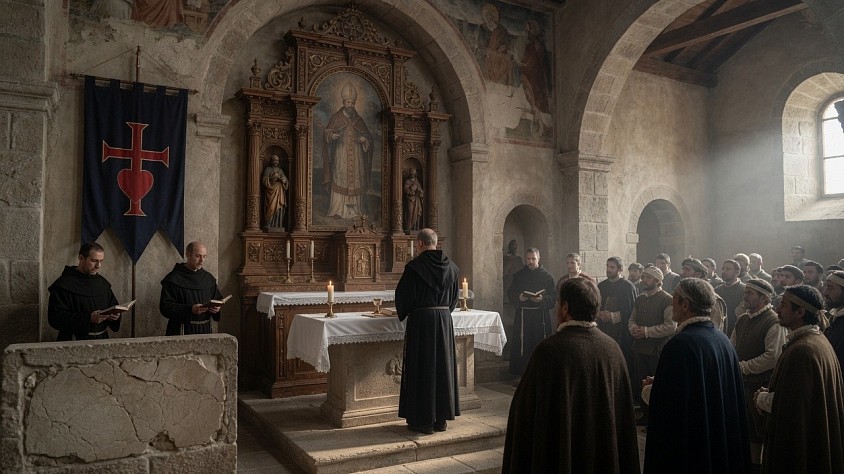
The Augustinians
The Order of Saint Augustine, a mendicant religious order within the Catholic Church, draws its spiritual foundation from the fourth-century Rule of St. Augustine, penned by the North African bishop and theologian St. Augustine of Hippo. This foundational text advocates a life of communal poverty, chastity, obedience, and fraternal charity, while urging active engagement in preaching, education, and pastoral ministry. Unlike cloistered contemplatives, Augustinians blend monastic discipline with apostolic zeal, fostering a tradition of intellectual rigor evident in Augustine’s seminal works like Confessions and City of God. Formally constituted in 1244 by Pope Innocent IV through the fusion of disparate hermit groups in Tuscany, the order swiftly expanded across Europe, establishing universities, hospitals, and mendicant houses that bridged faith and society. By the Renaissance, Augustinians had evolved into key players in the Counter-Reformation and global missions, their adaptability making them ideal companions for Spain’s imperial ventures.
The Augustinians’ views on the Spanish conquest embodied the era’s theological tensions: a fervent belief in universal salvation through Christ clashing with the moral ambiguities of empire-building. In the Americas, where they arrived in Mexico in 1533 under Fray Juan de Zumárraga, they spearheaded evangelization but soon confronted the horrors of conquest. Echoing the Dominican-led Valladolid debates (1550–1551), Augustinians like Fray Tomás de Mercado decried the encomienda system’s enslavement of indigenous peoples, forced relocations, and cultural devastation, arguing that true conversion demanded justice, not coercion. They advocated for doctrina christiana—gentle catechesis over violence—positioning themselves as protectors of natives, though their dependence on royal subsidies often compromised this independence. This “spiritual conquest” ideology justified expansion as a divine imperative, yet friars frequently mediated disputes, petitioning the Crown for reforms to curb encomendero abuses and soldierly rapacity.
In the Philippine Isles, the Augustinians’ perspective was markedly optimistic, portraying the 1565 conquest as a providential, relatively bloodless extension of Iberian dominion. Dispatched by King Philip II, the inaugural quartet—led by the seasoned cosmographer Fray Andrés de Urdaneta—disembarked in Cebu with Miguel López de Legazpi’s fleet on April 27, 1565, becoming the archipelago’s first Catholic missionaries. They hailed the rediscovery of the Santo Niño de Cebú, a wooden Christ child statue abandoned by Magellan’s 1521 expedition, as a miraculous portent of God’s favor, reframing colonization as reclamation rather than invasion. Urdaneta’s triumphant return to Mexico via the easterly tornavuelta route in 1565 not only fortified the Manila-Acapulco galleon trade but symbolized a seamless fusion of faith and filibusterismo, paving the way for over 3,000 friars’ arrival by century’s end. Skirmishes with Visayan datus and Moro sultans notwithstanding, Augustinians emphasized alliances through baptism—administering over 100,000 in the first decade—while protesting encomienda extortions in memorials to the Audiencia. Legazpi’s 1572 cedula real enshrined their mandate to “pacify and convert,” casting them as humane architects of a Catholic pueblo.
From 1565 to 1573, Augustinian convents and churches materialized as colonial crucibles, merging indigenous resilience with Hispanic permanence. Cebu’s inaugural convent, raised April 28, 1565, was a humble bamboo-nipa affair beside a thatched chapel for the Santo Niño, mimicking the elevated bahay kubo to withstand typhoons and facilitate swift masses. Vulnerable to raids, it hosted the first 800 baptisms by 1566. Exploratory forays yielded Panay’s 1569 wooden visitas in Oton and Jaro, featuring coral plinths, woven walls, and open naves for communal worship. Manila’s 1571 fall birthed the order’s stone flagship: the Parish of San Agustín in Intramuros, hewn from volcanic tuff and lime, with cloistered cells, a refectory, and vaulted sanctuary resilient to quakes. By 1572’s Provincial Chapter, expansions dotted Tondo and Laguna with hybrid designs—Filipino latticework adorning Spanish retablos—totaling twelve sites by 1573. These edifices not only sanctified landscapes but orchestrated reducción: natives resettled around church bells, forging enduring barrios where faith fortified fragile frontiers.